Research
Transition Matrix
How NCR ratings have migrated between categories, and what that says about their stability.
Transition rate
A transition rate represents the frequency at which credit ratings are upgraded, downgraded, or remain unchanged over a specified period. It can be calculated across the entire population of rated entities or focused on a specific rating category to assess rating stability or credit migration trends.
Transition study
A rating transition study examines how credit ratings evolve over time, providing insights into rating stability and migration patterns. This analysis is a key component of NCR's evaluation process, helping to assess the consistency and predictive performance of its credit ratings.
Methodology
NCR employs a rigorous and transparent methodology to analyse rating transitions. The key steps are as follows:
- Issuers are grouped into static pools, also known as cohorts, based on the year in which their ratings were active and outstanding at the beginning of that year.
- The study monitors long-term ratings that have been assigned and accepted by issuers on an annual basis, capturing upgrades, downgrades and reaffirmations.
- The analysis is conducted at issuer level, not instrument level. Each issuer is counted only once to avoid duplication and distortion.
- The study covers issuers across all major sectors, including banks, financial institutions and corporates.
- Separate cohorts are created for each financial year, tracking rating movements over the following twelve months.
- Data from all annual cohorts is consolidated into a weighted average transition matrix.
- Only issuers with active ratings at both the start and end of the observation period are included. Issuers whose ratings were withdrawn or suspended during the period are excluded from the respective opening cohort.
Corporate
NCR has conducted transition matrix analysis of rated corporate clients from 2018 to 2023, to see the percentage of change in credit rating within each rating category.
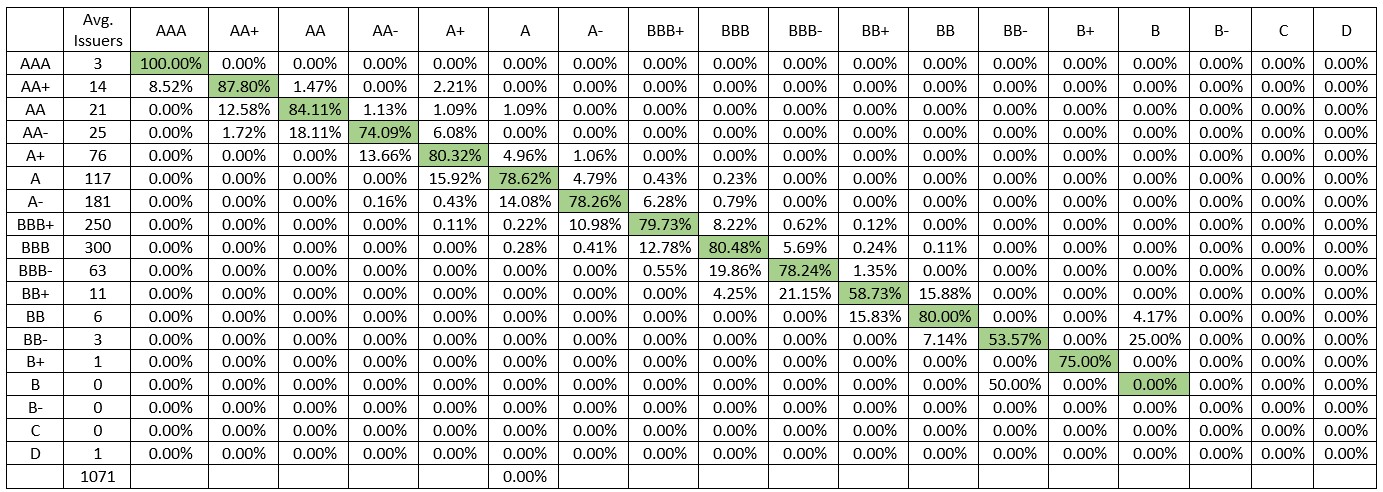
Based on NCR's weighted average one-year transition matrix, out of all the “A” rated companies at the beginning of the year, 78.62% remained in the same category, 15.92% were upgraded to “A+” and 4.97% were downgraded to “A-”. Similar inferences can be drawn for the other rating categories.
SME
NCR has also conducted transition matrix analysis of rated SME clients from 2018 to 2023.
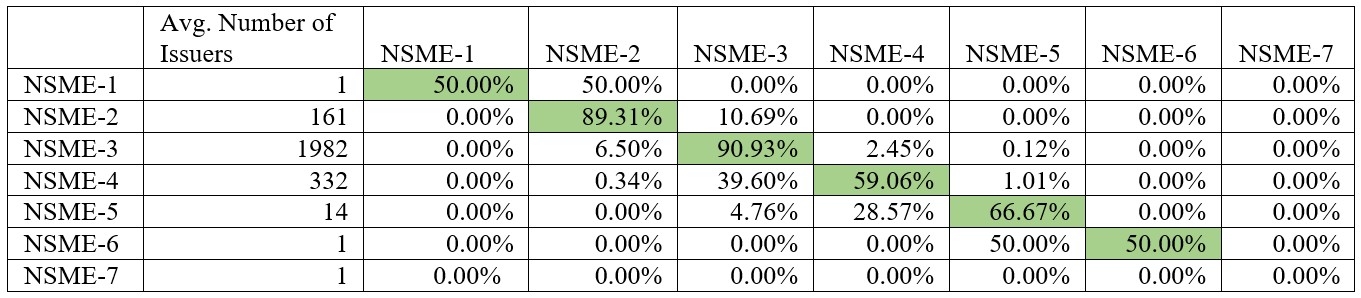
Out of all the “NSME-3” rated companies at the beginning of the year, 90.93% remained in the same category, 6.50% were upgraded to “NSME-2” and 2.45% were downgraded to “NSME-4”. Similar inferences can be drawn for the other rating categories.
Disclaimer
This study is developed by National Credit Ratings Limited (NCRL) based on data and information from secondary reliable sources, in compliance with the guidelines provided by the Bangladesh Securities and Exchange Commission and Bangladesh Bank. NCRL puts its best efforts into preparing this document. It may inherit human, technical or systematic error as its limitation, and NCRL therefore provides no warranty of any kind. This is the property of NCRL and none of the information may be copied, reproduced, stored or disseminated in whole or in part without the written consent of NCRL.
Download this document
PDF, opens in a new tab